


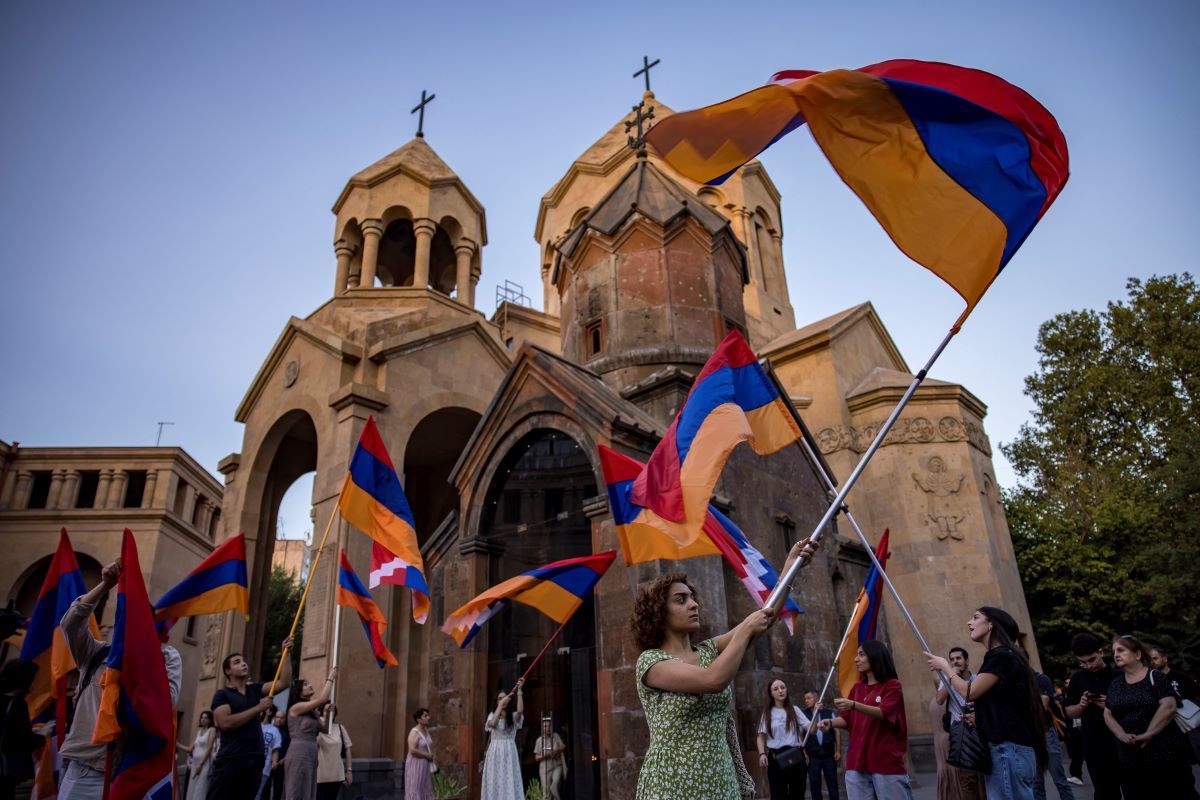

The war now unfolding around Iran will not only reshape the Middle East. It may also decide the fate of a small Christian nation sitting on one of the world’s most strategic crossroads.
Armenia, the world’s first Christian nation, sits at the intersection of energy routes, trade paths and great-power rivalry stretching from the Persian Gulf to the Black Sea. What happens inside Iran in the upcoming months could determine whether the South Caucasus becomes a connector between regions or a battleground for competing powers.
Iran occupies the southern hinge of this crowded neighborhood. It connects the energy-rich Gulf to the Black Sea and to Europe and borders a fragile arc of states whose futures remain contested. Armenia, a civilization that has preserved its faith for 17 centuries despite repeated invasions, is also a landlocked state still recovering from war and lies on one of the shortest north–south routes between these spaces.
The outcome of the current confrontation with Iran will help decide which of the three models prevails in this region. One model is a competitive corridor race dominated by larger powers. Another is a patchwork of quasi-sovereign spaces and frozen conflicts. A third is a rules-based network of lawful, state-controlled connectivity.
Three Irans and three south Caucasus futures
Three possible futures for Iran now dominate the strategic debate in light of recent United States and Israeli strikes and Iran’s missile and drone responses. Each scenario carries distinct consequences for the South Caucasus and for Armenia in particular.
The first possibility is fragmentation and weakened central authority. Commentators in Armenian and regional outlets warn that instability in Iran’s northwestern regions could generate new and unpredictable actors along Armenia’s southern border. They also warn that this instability could create significant refugee flows into the South Caucasus. For the region as a whole, this outcome would mean a looser and more volatile frontier where local militias, outside intelligence services, and rival capitals compete for leverage. For Armenia, it would mean heightened security risks in the Syunik region and new humanitarian pressures on a state with limited capacity to absorb such shocks.
A second scenario is a more centralized but security-dominated state in Tehran. Some research argues that sustained external pressure could push Iran further into isolation. Such pressure would deepen sanctions and reinforce hardline control over foreign and economic policy. Under that outcome, Iran would likely remain a significant regional actor but with fewer legal economic channels. This would increase the temptation to route trade, energy and influence through informal or gray networks. The South Caucasus would feel this through tighter sanctions enforcement, sharper scrutiny of north–south transit, and renewed pressure on states that depend on Iran for access.
Armenia is foremost among those states.
A third scenario is gradual political opening and economic reform. Initiatives such as the International North South Transport Corridor have long treated Iran as a potential pillar of a rules-based trade spine that connects the Indian Ocean to the Black Sea and to European markets. In that future, Iran would be more deeply tied into legal logistics, energy and financial networks. For the South Caucasus, that would mean more predictable transit regimes and a shift from corridor competition to corridor governance. For Armenia, it would create a more favorable environment in which to leverage its geography without constantly navigating around sanctions and great power red lines.
None of these outcomes is guaranteed. Each would redraw the strategic map in ways that policymakers in Washington, Brussels, Moscow, Ankara and regional capitals cannot afford to ignore.
Corridor politics and Syunik as a test case
Nowhere are these stakes clearer than in the struggle over corridor politics in the South Caucasus. Projects such as the International North South Transport Corridor and the proposed Persian Gulf to Black Sea route converge in and around Armenia’s Syunik province.
The Trump Route for International Peace and Prosperity, agreed between Armenia and Azerbaijan at the White House in August 2025, reflects a broader attempt to stabilize the region through lawful transit rather than coercion. It has already begun to redefine how outside powers think about transit, sovereignty and leverage in this narrow strip of land.
Many analyses stress that this territory is not only a local issue. It is a lever in broader contests over whether transit routes will respect existing borders or carve out new and extra-territorial spaces controlled by larger powers.
If Iran fragments or turns inward, there will be strong incentives for other regional actors to push alternative east–west routes that sideline both Iran and Armenia. That could mean renewed pressure for a corridor linking Azerbaijan to Nakhchivan under weakened Armenian control. It could also mean infrastructure packages in which Armenia is treated as a transit space rather than as a fully sovereign state.
If, by contrast, Iran stabilizes and remains engaged in regional trade, Tehran is likely to continue opposing transportation schemes that bypass its territory altogether. It is also likely to support routes that preserve recognized borders and provide mutually beneficial access. In that context, Armenia can serve as a state-controlled and internationally recognized land bridge between the Gulf, the Black Sea and Eurasia.
The way outside powers choose to treat Armenia in these debates will send a signal about their broader approach to small states in contested regions. The key question is whether they will support regional integration that reinforces sovereignty or tolerate arrangements that hollow it out.
Refuge, humanitarian strain, and political risk
The humanitarian dimension of the Iran crisis will also shape the region’s future. Recent reporting has highlighted Armenia’s role as an evacuation and transit corridor during episodes of heightened tension around Iran, and a serious breakdown inside the country could send refugees northward. For a nation of fewer than three million people — still coping with the displacement of Armenians from Nagorno-Karabakh — such an influx would place significant strain on public services and social cohesion.
In volatile regions, refugee flows rarely remain purely humanitarian; they quickly become strategic realities that neighboring powers attempt to exploit. If Western policymakers want a stable south Caucasus, they should begin preparing with Armenia now rather than scrambling in the middle of a crisis.
What policymakers should take from Armenia’s vantage point
Iran’s trajectory is not only a Middle East story. It is also a test of whether small states such as Armenia will be able to remain secure, connected and free to choose their own future within a stable international order.
For global readers and policymakers, Armenia’s experience offers three lessons for thinking about Iran’s future and about the wider region.
First, sovereignty and connectivity rise or fall together. Armenia’s position shows that when borders are pressured, and corridor arrangements are negotiated over the heads of small states, instability expands rather than contracts. Any strategy toward Iran that ignores how transit projects affect state control in the south Caucasus risks undermining the very order that it claims to defend.
Second, legal trade networks matter as much as military balances. In the best-case scenario for Iran, which would involve gradual opening and reform, initiatives such as the North-South Corridor and the Persian Gulf to Black Sea route offer a template for lawful connectivity. Such connectivity can reduce incentives for shadow networks and proxy confrontations. Keeping that option alive requires resisting shortcuts today that normalize extra-territorial corridors or overlook sanctions evasion tomorrow.
Third, humanitarian pressures are strategic issues. Refugee flows, evacuation routes and the absorption capacity of small frontline states should form part of policy planning. They should not be treated as complications that are addressed only after a crisis erupts. Armenia’s potential role as both a transit corridor and a temporary haven in future Iran crises should be resourced and governed accordingly.
The future of Iran will shape far more than the balance of power in the Persian Gulf. It will also determine whether countries like Armenia — small, democratic and historically Christian — can survive as sovereign states in a dangerous neighborhood.
If the region descends into fragmentation, corridor coercion and frozen conflicts, Armenia could once again find itself squeezed between larger powers. But if stability and lawful trade prevail, the south Caucasus could become a bridge connecting the Middle East, Europe and Asia. In that sense, Armenia’s fate is not just a regional issue. It is a test of whether the international order still protects small nations — or whether geography and power politics alone will decide their future.
Dr. Paul Murray is CEO of Save Armenia and a Christian leader engaged in global religious freedom and policy advocacy.
The war now unfolding around Iran will not only reshape the Middle East. It may also decide the fate of a small Christian nation sitting on one of the world’s most strategic crossroads.
Armenia, the world’s first Christian nation, sits at the intersection of energy routes, trade paths and great-power rivalry stretching from the Persian Gulf to the Black Sea. What happens inside Iran in the upcoming months could determine whether the South Caucasus becomes a connector between regions or a battleground for competing powers.
Iran occupies the southern hinge of this crowded neighborhood. It connects the energy-rich Gulf to the Black Sea and to Europe and borders a fragile arc of states whose futures remain contested. Armenia, a civilization that has preserved its faith for 17 centuries despite repeated invasions, is also a landlocked state still recovering from war and lies on one of the shortest north–south routes between these spaces.
The outcome of the current confrontation with Iran will help decide which of the three models prevails in this region. One model is a competitive corridor race dominated by larger powers. Another is a patchwork of quasi-sovereign spaces and frozen conflicts. A third is a rules-based network of lawful, state-controlled connectivity.
Three Irans and three south Caucasus futures
Three possible futures for Iran now dominate the strategic debate in light of recent United States and Israeli strikes and Iran’s missile and drone responses. Each scenario carries distinct consequences for the South Caucasus and for Armenia in particular.
The first possibility is fragmentation and weakened central authority. Commentators in Armenian and regional outlets warn that instability in Iran’s northwestern regions could generate new and unpredictable actors along Armenia’s southern border. They also warn that this instability could create significant refugee flows into the South Caucasus. For the region as a whole, this outcome would mean a looser and more volatile frontier where local militias, outside intelligence services, and rival capitals compete for leverage. For Armenia, it would mean heightened security risks in the Syunik region and new humanitarian pressures on a state with limited capacity to absorb such shocks.
A second scenario is a more centralized but security-dominated state in Tehran. Some research argues that sustained external pressure could push Iran further into isolation. Such pressure would deepen sanctions and reinforce hardline control over foreign and economic policy. Under that outcome, Iran would likely remain a significant regional actor but with fewer legal economic channels. This would increase the temptation to route trade, energy and influence through informal or gray networks. The South Caucasus would feel this through tighter sanctions enforcement, sharper scrutiny of north–south transit, and renewed pressure on states that depend on Iran for access.
Armenia is foremost among those states.
A third scenario is gradual political opening and economic reform. Initiatives such as the International North South Transport Corridor have long treated Iran as a potential pillar of a rules-based trade spine that connects the Indian Ocean to the Black Sea and to European markets. In that future, Iran would be more deeply tied into legal logistics, energy and financial networks. For the South Caucasus, that would mean more predictable transit regimes and a shift from corridor competition to corridor governance. For Armenia, it would create a more favorable environment in which to leverage its geography without constantly navigating around sanctions and great power red lines.
None of these outcomes is guaranteed. Each would redraw the strategic map in ways that policymakers in Washington, Brussels, Moscow, Ankara and regional capitals cannot afford to ignore.
Corridor politics and Syunik as a test case
Nowhere are these stakes clearer than in the struggle over corridor politics in the South Caucasus. Projects such as the International North South Transport Corridor and the proposed Persian Gulf to Black Sea route converge in and around Armenia’s Syunik province.
The Trump Route for International Peace and Prosperity, agreed between Armenia and Azerbaijan at the White House in August 2025, reflects a broader attempt to stabilize the region through lawful transit rather than coercion. It has already begun to redefine how outside powers think about transit, sovereignty and leverage in this narrow strip of land.
Many analyses stress that this territory is not only a local issue. It is a lever in broader contests over whether transit routes will respect existing borders or carve out new and extra-territorial spaces controlled by larger powers.
If Iran fragments or turns inward, there will be strong incentives for other regional actors to push alternative east–west routes that sideline both Iran and Armenia. That could mean renewed pressure for a corridor linking Azerbaijan to Nakhchivan under weakened Armenian control. It could also mean infrastructure packages in which Armenia is treated as a transit space rather than as a fully sovereign state.
If, by contrast, Iran stabilizes and remains engaged in regional trade, Tehran is likely to continue opposing transportation schemes that bypass its territory altogether. It is also likely to support routes that preserve recognized borders and provide mutually beneficial access. In that context, Armenia can serve as a state-controlled and internationally recognized land bridge between the Gulf, the Black Sea and Eurasia.
The way outside powers choose to treat Armenia in these debates will send a signal about their broader approach to small states in contested regions. The key question is whether they will support regional integration that reinforces sovereignty or tolerate arrangements that hollow it out.
Refuge, humanitarian strain, and political risk
The humanitarian dimension of the Iran crisis will also shape the region’s future. Recent reporting has highlighted Armenia’s role as an evacuation and transit corridor during episodes of heightened tension around Iran, and a serious breakdown inside the country could send refugees northward. For a nation of fewer than three million people — still coping with the displacement of Armenians from Nagorno-Karabakh — such an influx would place significant strain on public services and social cohesion.
In volatile regions, refugee flows rarely remain purely humanitarian; they quickly become strategic realities that neighboring powers attempt to exploit. If Western policymakers want a stable south Caucasus, they should begin preparing with Armenia now rather than scrambling in the middle of a crisis.
What policymakers should take from Armenia’s vantage point
Iran’s trajectory is not only a Middle East story. It is also a test of whether small states such as Armenia will be able to remain secure, connected and free to choose their own future within a stable international order.
For global readers and policymakers, Armenia’s experience offers three lessons for thinking about Iran’s future and about the wider region.
First, sovereignty and connectivity rise or fall together. Armenia’s position shows that when borders are pressured, and corridor arrangements are negotiated over the heads of small states, instability expands rather than contracts. Any strategy toward Iran that ignores how transit projects affect state control in the south Caucasus risks undermining the very order that it claims to defend.
Second, legal trade networks matter as much as military balances. In the best-case scenario for Iran, which would involve gradual opening and reform, initiatives such as the North-South Corridor and the Persian Gulf to Black Sea route offer a template for lawful connectivity. Such connectivity can reduce incentives for shadow networks and proxy confrontations. Keeping that option alive requires resisting shortcuts today that normalize extra-territorial corridors or overlook sanctions evasion tomorrow.
Third, humanitarian pressures are strategic issues. Refugee flows, evacuation routes and the absorption capacity of small frontline states should form part of policy planning. They should not be treated as complications that are addressed only after a crisis erupts. Armenia’s potential role as both a transit corridor and a temporary haven in future Iran crises should be resourced and governed accordingly.
The future of Iran will shape far more than the balance of power in the Persian Gulf. It will also determine whether countries like Armenia — small, democratic and historically Christian — can survive as sovereign states in a dangerous neighborhood.
If the region descends into fragmentation, corridor coercion and frozen conflicts, Armenia could once again find itself squeezed between larger powers. But if stability and lawful trade prevail, the south Caucasus could become a bridge connecting the Middle East, Europe and Asia. In that sense, Armenia’s fate is not just a regional issue. It is a test of whether the international order still protects small nations — or whether geography and power politics alone will decide their future.
Dr. Paul Murray is CEO of Save Armenia and a Christian leader engaged in global religious freedom and policy advocacy.


